- Home
- Harbor notes
- Ellis Island
Island notebook / 04
Follow the process, not only the family legend
Ellis Island becomes clearer when its famous rooms are read as parts of an inspection system shaped by shipping class, federal law, health judgments and unequal power.
The Great Hall is beautiful, but it was not designed as a ceremonial welcome. It was a Registry Room within a federal immigration station. People waited, answered questions and watched officials make decisions that could reunite a family, delay it or send someone back across the ocean.
Start with a necessary correction
Ellis Island was a major federal immigration station from 1892 until 1954, and more than 12 million immigrants passed through it. Yet it was never the entry point for every immigrant to the United States or even every arrival in New York Harbor.
During the peak era, many first- and second-class passengers received inspection aboard ship and proceeded to shore unless officials identified a concern. Steerage passengers were more commonly taken to Ellis Island. Class therefore shaped who experienced the station directly. Immigration through land borders, other ports, earlier periods and later airports also belongs to the national story.
Read the building in operational order
The Main Building was rebuilt after fire destroyed the first station in 1897. Its circulation made inspection visible and efficient. Bags were separated, people climbed stairs, medical officers observed movement and appearance, and legal inspectors compared answers with ship manifests. The Registry Room concentrated waiting and decisions under one roof.
The process could move quickly for most arrivals, but “most” should not erase the experience of those detained for medical evaluation, legal hearings, sponsorship questions or exclusion. Family members might face different outcomes. Interpreting the island means holding routine passage and profound uncertainty together.
Four museum questions
| Question | Evidence to seek | What it prevents |
|---|---|---|
| Who had to come here? | Shipping class, port practice and inspection rules | The claim that every immigrant followed one path |
| What could officials decide? | Medical marks, legal hearings, detention and appeals | A purely celebratory “welcome center” story |
| What laws shaped the room? | Changing exclusions, quotas and federal categories | Treating individual interviews as isolated events |
| Whose voice survives? | Oral histories, photographs, objects and records | Letting the institution speak for every migrant |
Law was present even when invisible
Inspectors did not invent the categories they enforced at each desk. Federal laws defined grounds for exclusion and changed across time. Race, nationality, disability, health, political belief, economic status and family relationship could all become subjects of state judgment under different statutes and practices.
This is why a room-by-room visit should connect personal testimony to policy. A difficult interview was not only a clash of personalities; it took place inside a legal system. The museum’s broader galleries help place the Ellis years within longer histories of migration before 1892 and after 1954.
Use photographs carefully
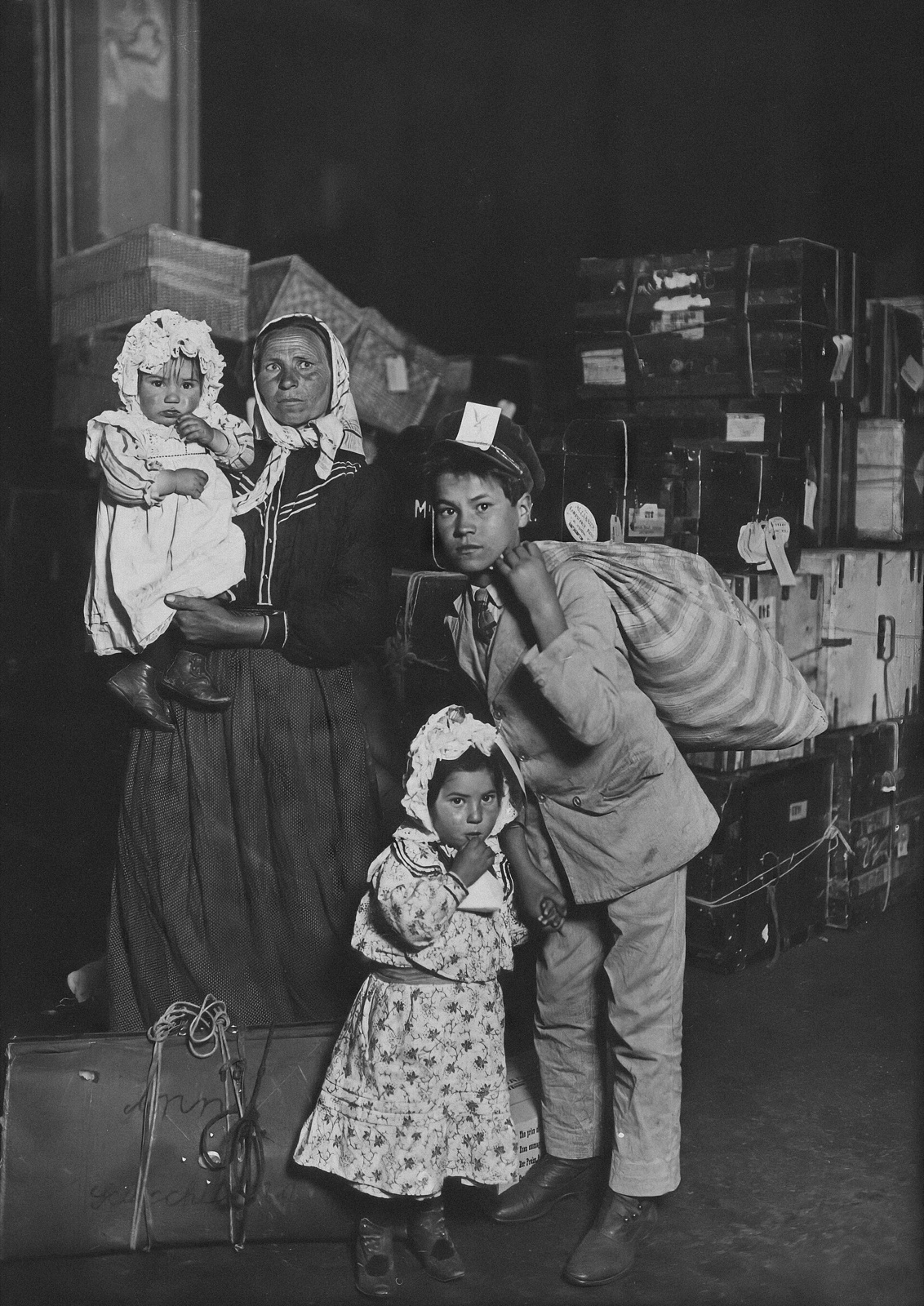
Lewis Hine’s Ellis Island portraits are compelling because individuals meet the camera directly. Hine was a sociologist and photographer whose work often advocated social reform. The images are historical sources, not transparent windows. Clothing, caption, setting, selection and the photographer’s purpose all shape what viewers see.
When a label identifies a person or group, read it. Do not turn a specific family into a generic symbol of “all immigrants.” Notice dignity and agency without inventing emotions. Silence in the record is not permission to supply a sentimental story.
Family research is evidence, not a verdict
Passenger records can be extraordinary, but name spellings, transcription, date memory, port differences and record gaps complicate a search. The familiar claim that officials changed immigrants’ names at Ellis Island is generally misleading: ship manifests were created before arrival, and inspectors worked from those records. Names could change later for many reasons.
A missing search result does not prove that a family story is false or that an ancestor never immigrated. Start with known dates, relatives, residences and naturalization records, then compare sources. Museum research services and archival databases have their own scope and limitations.
A focused route when time is short
- Pause outside to read the island as a complex of buildings, not only the Main Building façade.
- Enter through the baggage area and follow the historic movement upward.
- Spend unhurried time in the Great Hall, looking at circulation as well as architecture.
- Choose one inspection or hearing gallery and one personal-story section.
- End with a view back toward Liberty Island and the harbor route between the two sites.
Ellis Island is not a universal origin story. It is one powerful place where migration met the administrative state.
Keep the building human
Large numbers communicate scale but can flatten lives. Balance “more than 12 million” with one document, one oral history and one room. Ask what an individual knew at that moment, what officials knew, and what neither could predict. That shift turns a famous landmark into a place of contingency.